For e-commerce,
customer retention is the ultimate profit driver. The problem is that customers don't send an email saying, "I'm about to churn." They simply disappear, crippling your
LTV and making your
CAC look terrible.
The best defense against this silent killer is a well-designed
Post-Purchase Survey (PPS). It’s not just for collecting nice-to-know data; it's a
predictive diagnostic tool. The right questions, asked at the right time, are statistically proven to reveal friction points, unmet expectations, and weak product fit, the three main precursors to churn.
This guide provides a checklist of the most powerful questions you must use to predict and prevent customers from leaving after their first purchase.
The Predictive Power of the PPS
Post-Purchase Surveys act as an early warning system because they capture customer sentiment while the experience is fresh.
- Capture the Gap: They specifically identify the gap between the customer’s
pre-purchase expectations (driven by your marketing) and their
post-purchase reality (driven by logistics and product quality).
- Segment for Intervention: Customers whose answers reveal high friction or low value can be immediately segmented and flagged for a human or automated retention sequence (e.g., a proactive support email or a surprise discount).
- Inform Acquisition: By understanding why a customer was dissatisfied, you can adjust your marketing messaging to attract customers who are a better, more profitable fit in the future.
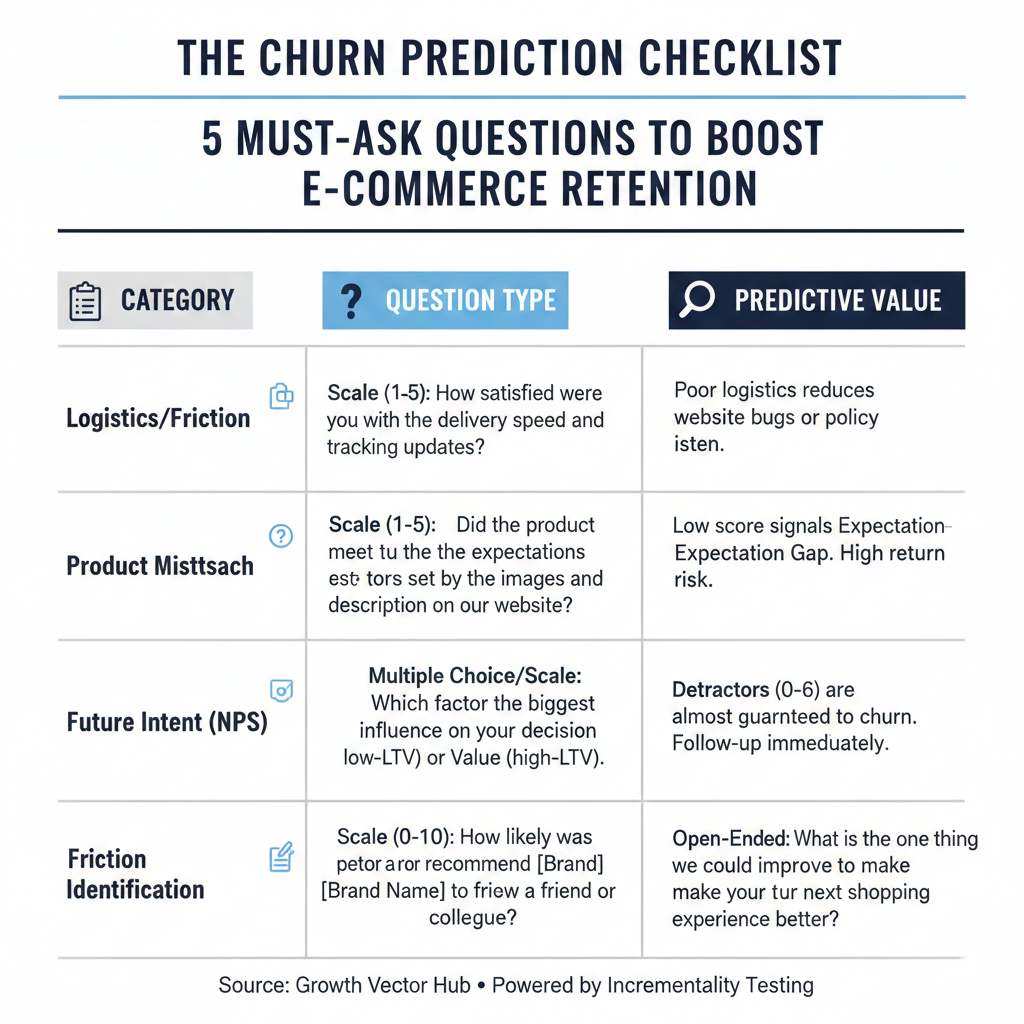
The Churn Prediction Checklist: 5 Must-Ask Questions
These questions are structured to isolate the three biggest drivers of e-commerce churn:
Delivery/Logistics Friction, Product-Expectation Mismatch, and Low Loyalty.